
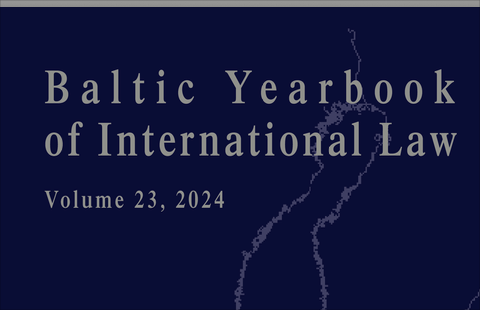
The 23rd volume of the Baltic Yearbook of International Law is published.
The articles published in this volume under the theme “Lithuanian Tradition in and Research on International Law” highlight Lithuania’s evolving legal tradition and engagement with international law, demonstrating how the country is navigating the complex interplay between developments in national, European and international law. The Yearbook’s General articles section also includes articles on two particularly challenging topics: the prohibition of nuclear weapons, and the challenges of AI.
The strength of the international legal order lies in its capacity to evolve, adjust, innovate and provide concrete solutions to emerging challenges. Legal scholarship plays a crucial role in these efforts. Volume 23 continues to contribute to this mission by addressing some of the most urgent legal questions of our time, such as accountability for the most serious of crimes, the restoration of statehood, environmental protection, energy security, digital transformation and artificial intelligence.
The Yearbook contains state practice reports from Estonia, Latvia and Lithuania, thus serving as an important source of international law which is unavailable elsewhere.
Volume online is published on Brill’s website:
The Baltic Yearbook of International Law (BYIL) is an annual legal journal published by the Riga Graduate School of Law (RGSL) in cooperation with Brill Publishers. The Editors-in-Chief of the Yearbook are Ineta Ziemele, Judge at the European Court of Justice and Professor of RGSL (Latvia); Lauri Mälksoo, Professor of International Law, University of Tartu (Estonia); Dainius Žalimas, Member of the European Parliament, former Dean of the Law Faculty at the Vytautas Magnus University (Lithuania). Managing Editor: Ligita Gjortlere, RGSL.
Articles published in the Yearbook are peer-reviewed. In 2023, the Baltic Yearbook of International Law articles were added to the Scopus database. This gives a broader audience to the existing and future authors published in the Yearbook, as their articles are already and will be searchable in Scopus, one of the biggest bibliographic and citation databases of multidisciplinary scientific publications.