
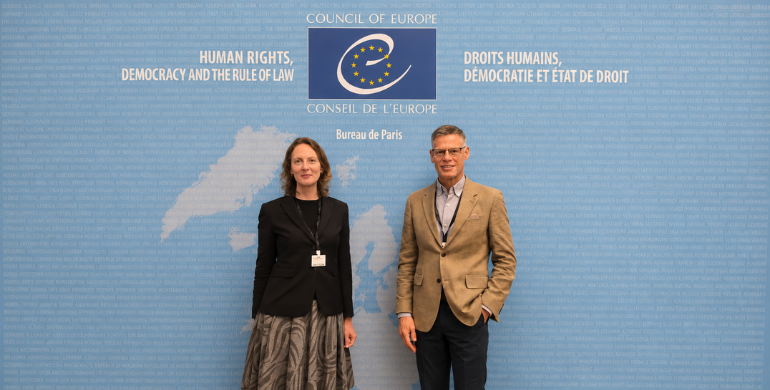
Riga Graduate School of Law (RGSL) will contribute legal and educational expertise to the Council of Europe's work on developing a legal instrument governing the use of artificial intelligence systems in education.
The project forms part of the Council of Europe's wider programme on artificial intelligence and education, which seeks to ensure that technological innovation supports quality education while respecting human rights, democratic values and the rule of law. The work is being undertaken under the auspices of the Committee of Experts on Artificial Intelligence and Education (EDU-IA), established by the Council of Europe's Steering Committee for Education.
EDU-IA brings together experts appointed by Council of Europe member states, alongside observers and other participants, to develop legal and policy instruments addressing the growing use of AI throughout education. Its work includes a proposal for a legal instrument to regulate AI systems in education, a policy toolbox for teaching and learning about AI, a European framework for evaluating educational technologies, and guidelines on the use of educational data and analytics.
Dr Mark Leiser, newly appointed Associate Professor of Digital Regulation and Disruptive Technology at RGSL, will act as the project's lead legal expert and principal drafter. He will undertake the comparative legal analysis and prepare the principal drafting materials, including the draft legal instrument and its accompanying explanatory documentation, for consideration within the Council of Europe's intergovernmental process.
The project will examine how legal safeguards can protect learners, preserve the professional autonomy of educators, support meaningful parental participation, and establish clear responsibilities for educational institutions, public authorities and technology providers. It will also consider how regulation can address risks involving automated assessment, profiling, discrimination, data governance and over-reliance on AI without preventing educational institutions from making responsible use of beneficial technologies.
Dr Mark Leiser, Associate Professor of Digital Regulation and Disruptive Technology, RGSL:
"Artificial intelligence is already changing how learners are taught, assessed and understood, which means that the legal framework cannot be confined to responding after something has gone wrong. Our task is to translate the Council of Europe's commitments to human rights, democracy, and the rule of law into practical, legally coherent safeguards that protect learners and educators while leaving room for responsible innovation. Education should benefit from AI, but automated systems must not displace professional judgement, narrow educational opportunities or weaken the human relationships on which quality education depends."
Dr Laura Ratniece, Rector and Associate Professor, Riga Graduate School of Law:
"RGSL is honoured to contribute to the Council of Europe's work on regulating AI in education, and we are committed to delivering meaningful results. Participation in this project aligns with RGSL's strategic goal of sharing our expertise in education. Over the last few years, we have acquired considerable expertise regarding the use of AI in higher education, and we see a clear need to continue advancing work in this field."
The project strengthens RGSL's engagement with international institutions working at the intersection of law, education and technological change. It also reflects the School's expanding research and teaching expertise in artificial intelligence governance, digital regulation and the legal implications of emerging technologies.
The resulting drafts will contribute to the deliberations of EDU-IA and the Steering Committee for Education. The final form and content of any Council of Europe instrument will remain subject to the organisation's intergovernmental consideration and approval procedures.
Photo: Jen Persson
Further Information